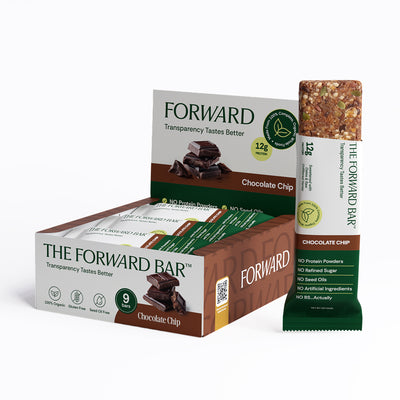
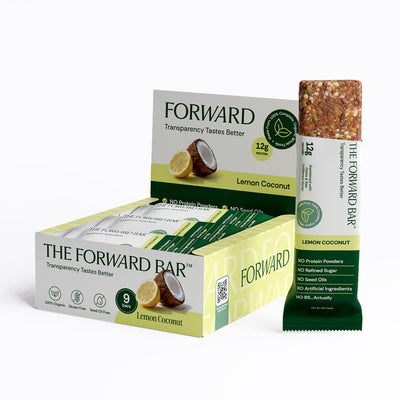
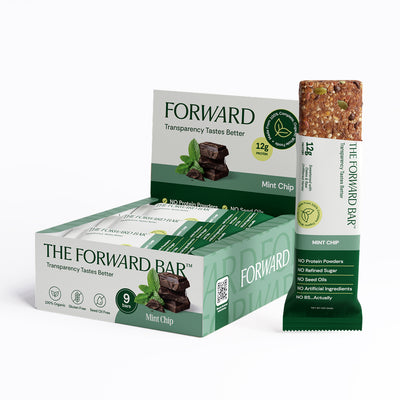
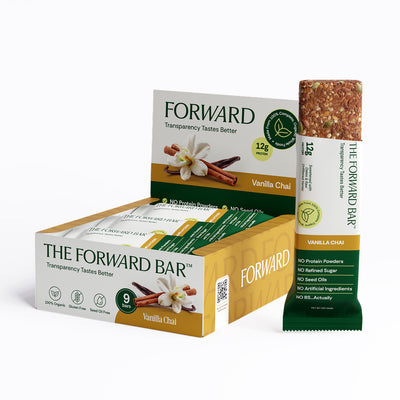
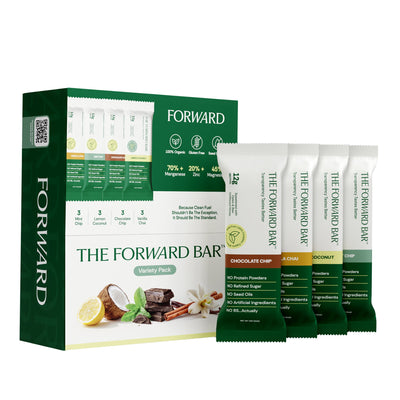


Every bar has to solve two problems at once: it has to taste good enough to eat again, and it has to hold together. Most solve both with syrup. We solve both with dates.
Dates are a whole fruit, so they arrive with fiber, potassium and polyphenols still attached to their sugars. That does not make them calorie-free or sugar-free, and we are not going to pretend otherwise.
Here is what dates do in the recipe, what the fiber actually changes, and how to think about sugar in a bar sweetened this way.
Sweetener and binder in one ingredient
Dates are sticky when blended, which means they hold seeds and nuts together without added oils, gums or syrups. Remove them and the recipe needs a manufactured binder — usually a syrup, sometimes a starch.
They are also why the bar contains no sugar alcohols. Erythritol, maltitol and sorbitol are common in low-sugar bars and are a frequent cause of the bloating and digestive complaints people report with protein bars. We avoid the category entirely.
Sugar in whole fruit versus added sugar
The honest framing is this: dates contain sugar. What differs is the matrix it arrives in.
In whole dates, sugars come packaged with fiber, potassium and polyphenols. Dietary fiber slows gastric emptying and moderates the rate of glucose absorption — this is well-established physiology, and it is why whole fruit and fruit juice behave differently in the body despite similar sugar content.
Under FDA labeling rules, sugars naturally present in whole fruit are not counted as “added sugars”. That is a regulatory distinction, not a health claim, and we are citing it as the former.
What we won't claim about dates
You will sometimes see dates described as “low glycaemic” with a specific number attached. Published glycaemic index values for dates vary considerably by variety, ripeness and testing method, and a single figure quoted without that context is misleading.
What we will say: dates are a whole fruit eaten with fiber, fat and protein in this bar, and mixed meals raise blood glucose differently from the same carbohydrate eaten alone. If you manage diabetes, the relevant number is your own glucose response, not an average from a study.
Dates: common questions
Are dates healthy?
Dates are a whole fruit that supplies fiber, potassium and polyphenols along with their natural sugars. They are also energy-dense. Whether that fits your diet depends on the quantity and the context — the fiber matters, and so does the portion.
Do dates count as added sugar?
No. Under FDA labeling rules, sugars naturally present in whole fruit are not classified as added sugars. This is a labeling definition, not a statement about health effects.
Why not use a sugar-free sweetener instead?
Because the common alternatives are sugar alcohols and high-intensity sweeteners, and sugar alcohols in particular are a well-known cause of bloating and digestive discomfort. Dates let us sweeten and bind with one whole-food ingredient.
Sources
Every nutrient statement on this page is supported by one of the following. We cite institutional and peer-reviewed sources only.
- USDA FoodData Central U.S. Department of Agriculture Reference composition data for whole foods
- Potassium — Fact Sheet for Health Professionals NIH Office of Dietary Supplements Potassium's role and typical intakes
- The Nutrition Source Harvard T.H. Chan School of Public Health Evidence reviews on nuts, seeds, fats and fiber
- Daily Value on the Nutrition and Supplement Facts labels U.S. Food and Drug Administration How %DV is defined and calculated
Links last checked 2026-07-31. Nutrient amounts for The Forward Bar come from our own product testing and appear on the pack and on each product page.


