

After 40 Years of Reading Labels, I Finally Found a Protein Bar Made With Whole-Food Protein — Not Protein Powder

By Pat Ellis
Published:
After 40 Years of Reading Labels, I Finally Found a Protein Bar Made With Whole-Food Protein — Not Protein Powder
By Pat Ellis
Published:
My daughter handed me one of these bars over dinner a few months ago. I flipped it over and read the label, expecting to be disappointed. Instead, what I read rewrote everything I knew about "healthy" protein bars — and finally gave me one I could trust.
My name is Pat. I'm 64 years old.

I have two daughters, four grandkids, and a pantry full of half-eaten "healthy" snacks I probably shouldn't have bought.
I've been reading ingredient labels since I was a young mother. Back then it was "no MSG" and "no BHT/BHA (artificial preservatives)." These days the list of things I look out for is a lot longer.
I'm not impressed by the front of a package. I flip it over.
The problem with most bars

Here's what I keep seeing on the grocery store shelf:
A bar with 22 grams of protein and an ingredient list as long as my arm (half of which I couldn't pronounce).
A "clean" brand. Looked great on the front. Whey protein isolate on the back. Even the "clean" brand was selling me processed protein.
A "whole food" bar that had to live in the fridge. Good quality, but I could never take it on the go.
A "natural" bar with sugar alcohols. Gave me a stomachache.
A nut bar that tasted fine but only had four grams of protein. Barely worth opening.
Ten years. Probably forty bars. Same letdown every time.
I'd started telling myself that maybe a "healthy" protein bar just doesn't exist. Maybe that's the catch. Maybe I was supposed to choose between healthy and convenient and stop expecting both in the same wrapper.
Ten years. Probably forty bars. Same letdown every time."
Then my daughter showed up.
"Mom — read the label."

My older daughter is in her thirties. She and her husband read every label, won't bring junk into the house, and are really on top of nutrition. So when she recommends a snack, I take it seriously — but I still flip everything over and read the label myself.
A couple of months ago she came over for dinner. After we ate, she pulled a bar out of her purse and slid it across the table.
"Mom. Read this label."
Pumpkin seeds. Hemp seeds. Dates. Almonds. Raw honey. Flax seeds. Psyllium husk. Plus real chocolate chips.
That was it.
I read it again to be sure of what I was seeing, then asked where she found it. She wrote down the name on the back of an envelope and slid it across to me.
I tucked it into my purse.
One thing almost every protein bar hides

After she left that night I dug into it. And I learned something that's bothered me ever since.
Almost every protein bar in the grocery store — even the ones that say "clean" or "real food" or "no junk" on the front — gets its protein from something processed. Whey isolate. Soy isolate. Pea protein. Brown rice protein.
Here's the tell, in case you've never noticed it before: anywhere you see the word protein on its own line in the ingredient list — "pea protein," "whey protein isolate," "rice protein concentrate" — that protein has been pulled out of the food it came from. Stripped down. Concentrated. Then stirred back into the bar as a powder.
I'd been reading labels for forty years and somehow nobody had ever told me that the word protein on most ingredient lists doesn't mean food. It means powder.
"The word 'protein' on most ingredient lists doesn't mean food. It means powder."
Once I understood this, I went and looked at every bar in my pantry. The clean brand. The natural brand. The whole-food brand. Same story on every back panel.
I wasn't crazy. The labels really had been hiding something all those years. I'd just been looking at the wrong line.
Why every protein bar uses powder

I have a friend who used to work in food product development. I called her and asked why.
She gave me three reasons.
Cost. Whole seeds and nuts are expensive. Protein isolate is cheap.
Formulation. It's hard to hit a target protein number from whole food alone. With a powder, you can dial in any number you want. With seeds, you have to figure out how much actually fits in a bar without it falling apart.
What people expect. A lot of folks buying protein bars want twenty grams or more on the front of the package. You can't get there from seeds without baking a brick.
So somewhere along the way, the protein bar industry made a choice. Protein number on the front, processed powder on the back, real food off the table.
When I told her about the bar my daughter had given me, she said: "The bar you described is unusual. That's a lot harder to make."
What's actually in the bar my daughter gave me

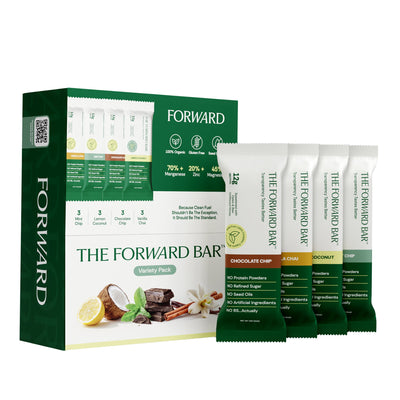
The bar I'd tucked into my purse is called The Forward Bar. And my research on it turned up some pleasantly surprising facts.
Here's what makes it different from every other bar I'd been reading the back of for years: there's no protein powder in it. None. The pumpkin seeds and hemp seeds and almonds you can see in every bite are where the twelve grams of protein actually come from. Nothing extracted. Nothing isolated. Nothing shaken back in.
The seeds and almonds are the protein. Not a powder added to the bar.
I'm not a nutritionist. I'm just sharing what I read about each ingredient.

Pumpkin seeds
One of the most concentrated plant sources of zinc and magnesium I came across. Zinc plays a role in immune function. Magnesium supports muscle and nerve function and is associated with healthy sleep — something I've started to care more about in my sixties than I ever did in my thirties.

Hemp seeds
A complete protein with all 9 essential amino acids — plus omega-3s and omega-6s in the ideal 3:1 ratio, which are believed to support heart and brain health.

Dates
Just dates. Naturally sweet enough that nothing else has to be added — they're the binder and the sugar. They're also low on the glycemic index, so the energy comes in steadier instead of all at once.

Almonds
A whole-food source of vitamin E and healthy fats. Vitamin E is an antioxidant believed to help protect cells from oxidative damage.

Raw, unfiltered honey.
Not the processed kind in the squeeze bear. The kind that still has its trace minerals and enzymes. Humans have eaten honey for thousands of years; it's not a new ingredient.

Flax seeds.
Contain compounds called lignans (believed to have antioxidant properties) and ALA, a plant-based omega-3 associated with cardiovascular health.

Psyllium husk
A plant fiber that's known to support digestive regularity. Many people find that whole-food fiber feels different in the gut than the synthetic kind added to a lot of processed bars.
Seven things. I recognized every one as a real food. Together they deliver 12 grams of protein, 4 grams of fiber, and 45% of a day's worth of magnesium — without a single ingredient that didn't grow from the ground.
Where the flavors come from

Once I trusted what was in the base of the bar, I started looking at the flavors.
With most snacks I've bought, that's where the label gets vague. Natural flavor. Natural flavoring. Some kind of extract with a name I can't pronounce. Whatever sleight of hand makes a "strawberry" bar taste like strawberry without ever touching one.
Here's what I found on the back of each Forward Bar flavor instead:

Chocolate Chip
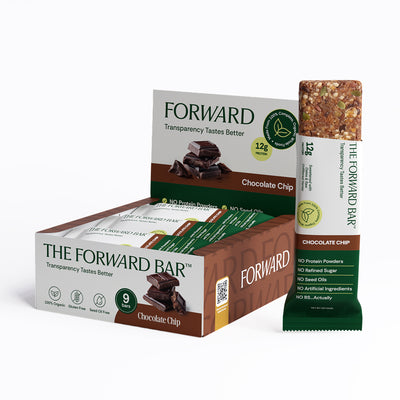
Fair-trade dark chocolate chunks, blended in with the seeds.

Mint Chip
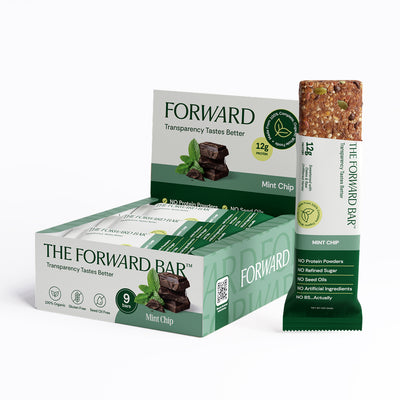
Real peppermint oil. Real dark chocolate chips.

Vanilla Chai
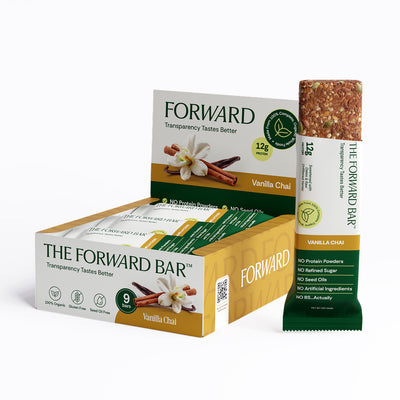
Cinnamon, cardamom, ginger, clove, nutmeg, and pure vanilla extract.

Lemon Coconut
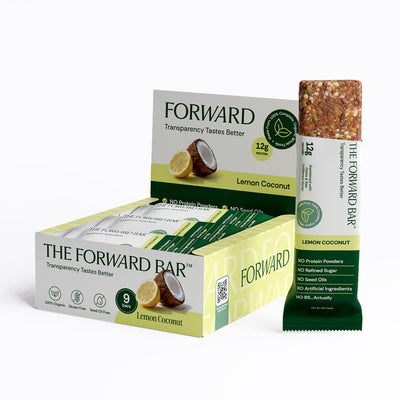
Lemon zest, lemon oil, and shredded coconut.
You won't find a "cookie dough" Forward Bar. Or a "birthday cake" one. Or anything else that doesn't grow from the earth.
Cookie dough isn't a real ingredient. It's a flavor compound engineered in a laboratory to make a bar taste like something it isn't. If a bar has to fake it to taste good, it's not real food.
What I noticed after a few weeks

After doing my research, it was clear that The Forward Bar was one of the healthiest bars I'd ever come across. So I ordered my own box and started eating one every morning with my coffee.
Here are a few things I noticed:
First, my stomach felt fine. With most of the other bars I'd tried there was always a little something — bloat, or that hollow rumbling that meant I'd be hungry again in an hour. With this one, no rumble.
Second, after a few weeks, the afternoon slump that used to hit me around 3 PM got softer.
Then one day I caught myself reaching for a Forward Bar in the afternoon before I reached for cookies (my one guilty pleasure). That hadn't happened in years.
And here's something else I didn't expect: the pantry shame went away. I stopped feeling like I had to choose between healthy and convenient.
That sounds small. But if you read labels, you know it isn't.
"The pantry shame went away. I stopped feeling like I had to choose between healthy and convenient."
I'm one of many happy customers

When I went online to read what other people thought, I realized a lot of folks felt the same way I did:
"I normally do not eat protein bars. My line is 'I would rather have a turkey sandwich.' That has changed. Now when I am hungry and need to eat something quickly, I will have a Forward Bar."
— Karen. ★★★★★
"I've tried a bunch of different brands of protein bars in the past. Only to be disappointed over the quality of products available. Too many came with sugar alcohols (from my research these are biologically inflammatory), other negative ingredients. I ordered the Variety Pack and was really surprised at how consistently good each bar was. Naturally sweetened, these are my 'go to' choice to give me that late afternoon boost, without the guilt."
— Rick S. ★★★★★
"I just reordered these as they definitely live up to the description. Best protein bar I've had and super healthy."
— Susie ★★★★★
"I'm genuinely impressed with The Forward Bar. It's rare to find a product that not only tastes incredible but also stays true to a meaningful mission. The flavor is outstanding and the ingredients are clean, thoughtful, and clearly chosen with intention."
— Douglas . ★★★★★
I've handed three of these to friends since I started eating them. They've all ordered their own.
If you want to try The Forward Bar

If you've made it this far, you're probably curious like I was.
The brand is running a major promotion: 30% off your first order of 3 boxes – a one-month supply – or 50% your first order of 9 boxes, which will last you three months! You can get the satisfaction of a delicious bar made with all organic ingredients for as low as $2.22 each.
Even better, you can mix and match your flavors. Try them all, or double down on familiar favorites like Chocolate Chip and Mint Chip.
And if even one of the flavors isn't a yes for you, the brand will refund the whole box. 30 days. No questions, no fine print. They call it the 30-Day "You'll Love It" Guarantee.
Here’s a link to The Forward Bar website so you can try them for yourself:
>> Get UP TO 50% OFF The Forward Bar <<
Frequently Asked Questions
I'm not an expert on the brand, so here are a few helpful answers I pulled straight from the Forward Bar site:
What's actually in a Forward Bar?
Seven core ingredients: pumpkin seeds, hemp seeds, dates, almonds, raw unfiltered honey, flax seeds, and psyllium husk. Plus the real food that makes each flavor — fair-trade dark chocolate, peppermint oil, chai spices, lemon zest, shredded coconut, vanilla extract.
How much protein does each bar have, and where does it come from?
12 grams of complete plant protein per bar. All of it comes from the whole seeds and almonds in the bar — no protein powder, no isolates, no concentrates of any kind.
Is it gluten-free, dairy-free, and soy-free?
Yes to all three. Also no refined sugar, no seed oils, no fillers, and no artificial flavoring.
What is psyllium husk and why is it in there?
Psyllium husk is a natural plant fiber that's known to support digestive regularity. It also helps hold the bar together without artificial binders or gums.
How is this different from other "clean" protein bars?
Most "clean" protein bars still get their protein from a processed powder — whey isolate, pea protein, brown rice protein. Forward gets all 12 grams from whole seeds and almonds, with no powder of any kind.
How does the subscription work, and can I cancel anytime?
Subscribe & Save gets you 15% off, with delivery every 2, 4, 6, or 8 weeks. You can pause, skip, or cancel anytime through your account.
What if I don't love a flavor?
The brand offers a 60-Day "You'll Love It" Guarantee. If even one flavor isn't a yes for you, they'll refund the whole box. No questions.
>> Get UP TO 50% OFF The Forward Bar <<
These statements have not been evaluated by the Food and Drug Administration. This product is not intended to diagnose, treat, cure, or prevent any disease. Results may vary.
© 2026, The Forward Bar