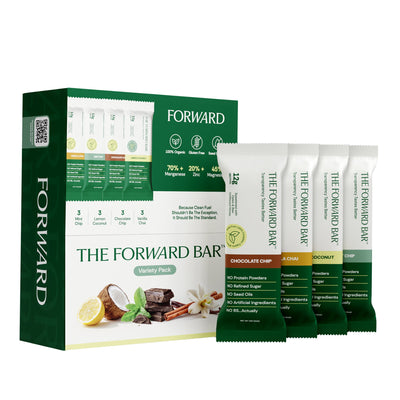


Flip over almost any packaged snack and you’ll see bold claims on the front:
- High protein
- All natural
- Low sugar
- Clean ingredients
But the real story isn’t on the front of the package. It’s on the back.
If you want to make better nutrition decisions, learning how to read an ingredient label is one of the most powerful skills you can develop. Marketing language is optional. Ingredient lists are regulated.
At The Forward Bar, we believe transparency shouldn’t require detective work. But until every brand prioritizes simplicity, here’s how to read ingredient labels like a pro.
Step 1: Read the Ingredient List, Not the Claims
The front of the package is designed to sell.
The ingredient list is designed to disclose.
Ignore phrases like “healthy,” “natural,” or “keto-friendly” at first. Turn the product around and read the ingredients from top to bottom.
Ingredients are listed in descending order by weight. That means the first few ingredients make up the majority of the product.
If sugar, syrup, or refined oils are at the top, that tells you more than any front-facing claim ever could.
Step 2: Count the Ingredients
This isn’t a strict rule, but it’s a helpful filter.
If a protein bar has 25–40 ingredients, chances are it’s heavily formulated. Many ultra-processed snacks rely on stabilizers, emulsifiers, preservatives, flavorings, and isolates to achieve shelf life and texture.
Ask yourself:
- Do I recognize most of these?
- Could I reasonably find them in a grocery store?
- Do they sound like food, or chemistry?
At The Forward Bar, we intentionally keep our ingredient list short and recognizable. If you need a glossary to understand what you’re eating, that’s usually a red flag.
Step 3: Watch for Hidden Sugar Names
Sugar doesn’t always appear as “sugar.”
It may show up as:
- Cane syrup
- Brown rice syrup
- Tapioca syrup
- Maltodextrin
- Agave nectar
- Evaporated cane juice
Even if a product says “no refined sugar,” scan carefully. Multiple sweeteners can be used in smaller amounts so they appear lower on the list individually, even though collectively they dominate the formula.
A pro tip: if several forms of sugar appear throughout the list, the product is likely more sugar-heavy than it appears.
We take a simpler approach: our sweetness comes directly from organic dates and organic raw unfiltered honey, no syrups, no sugar alcohol blends, no chemical substitutes.
Step 4: Understand Protein Sources
If you’re reading a protein bar label, look closely at where the protein comes from.
Common sources include:
- Whey protein isolate
- Pea protein isolate
- Soy protein concentrate
- Brown rice protein
Protein isolates are highly processed. They are extracted, filtered, and refined to separate protein from the original whole food.
While isolates can boost protein numbers on a label, they are far removed from their natural form.
Whole food protein sources, like seeds and nuts, provide protein along with fiber, minerals, and healthy fats. They exist in their natural matrix, not as an isolated fraction.
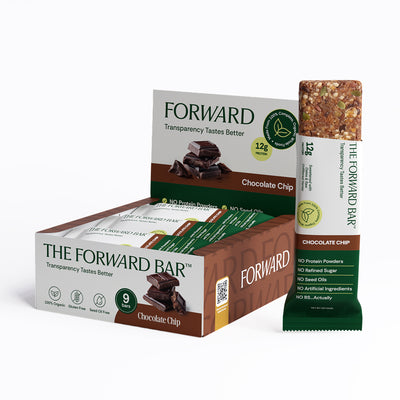
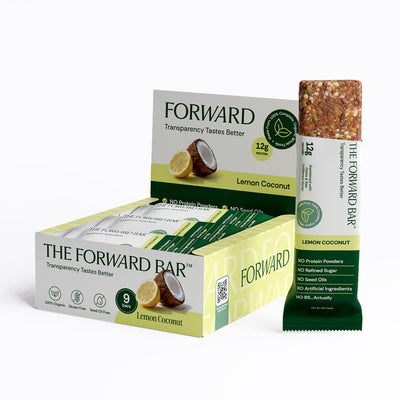
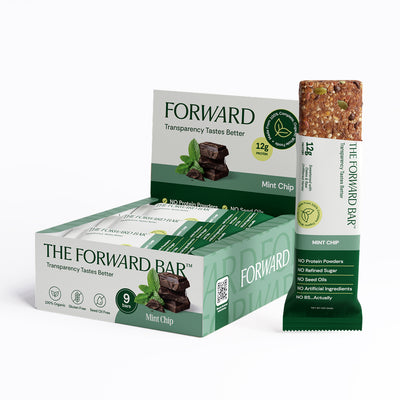
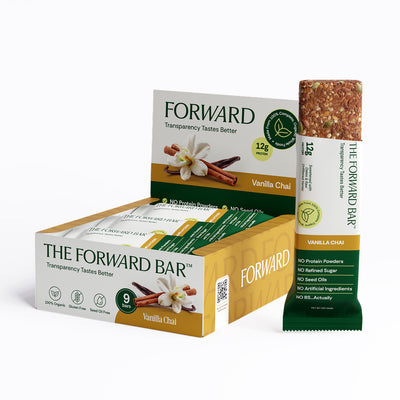
At The Forward Bar, we don’t use protein powder. Our protein comes directly from whole seeds. That means no industrial extraction process and no protein inflation for marketing purposes.
Step 5: Look for “Natural Flavors”
“Natural flavors” sounds harmless, even healthy. But it’s one of the most misunderstood ingredients on modern labels.
Natural flavors are chemically extracted compounds derived from natural sources. They are engineered to create specific tastes and aromas. Companies are not required to disclose the individual components of these proprietary blends.
If you’re aiming for clean-label eating, natural flavors are often a sign of flavor engineering rather than real ingredient-based taste.
We don’t use natural flavors. The flavor of our bars comes directly from the ingredients themselves- real food doesn’t need to be masked or reconstructed.
Step 6: Scan for Industrial Oils
Many snack bars use refined seed oils like:
- Canola oil
- Soybean oil
- Sunflower oil
- Safflower oil
These oils are inexpensive and shelf-stable but are heavily processed using heat and chemical solvents.
When reading labels, check whether oils are among the first few ingredients. If so, the product may rely on refined fats as a structural base.
We avoid seed oils entirely. Our structure comes from whole food ingredients - not industrial oils.
Step 7: Check for Sugar Alcohols & Artificial Sweeteners
Some “low sugar” bars replace traditional sweeteners with:
- Erythritol
- Maltitol
- Sorbitol
- Sucralose
While these may lower calorie counts on paper, they can cause digestive discomfort for some individuals and overstimulate sweet taste receptors.
If you’re reading labels like a pro, recognize that “low sugar” doesn’t automatically mean better.
Balanced macronutrients, protein, fiber, and healthy fats, matter more than manipulated sweetness.
Step 8: Ask One Simple Question
When you finish reading the ingredient list, ask:
Does this look like food?
Not perfect. Not trendy. Just food.
If the answer feels complicated, that’s useful information.
At The Forward Bar, our ingredient list is intentionally simple:
Whole seeds. Organic dates. Organic raw unfiltered honey. Real spices.
No protein powders.
No natural flavors.
No refined sugar.
No seed oils.
When you read our label, you don’t need interpretation.
Why Reading Labels Matters More Than Ever
Modern food manufacturing has become highly sophisticated. Products are engineered for shelf life, mouthfeel, and cost efficiency. Nutrition numbers on the front of the package often tell only part of the story.
Two protein bars may both list:
- 12 grams of protein
- 200 calories
But the ingredient lists can be entirely different, one built from whole foods, the other from isolates, syrups, emulsifiers, and flavor blends.
Reading labels empowers you to see beyond marketing.
It shifts the focus from macro-counting to ingredient integrity.
And over time, those choices add up.
We believe you shouldn’t need to be a food scientist to choose a clean snack.
Reading ingredient labels like a pro ultimately leads to a simple conclusion: the fewer engineered ingredients, the better.
Whole foods don’t require explanation.
Transparency doesn’t require fine print.
If you can recognize every ingredient, understand its purpose, and trust its source, you’re on the right track.
Forward means better ingredients.
Forward means transparency.
Forward means knowing exactly what you’re eating.


