

Protein powders are often marketed as a daily health essential - convenient, efficient, and packed with protein. But a recent investigation by Consumer Reports has raised serious questions about what may be hiding in many of these products.
In its latest testing, Consumer Reports analyzed 23 widely sold protein powders and ready-to-drink shakes and found that many contained measurable levels of heavy metals, including lead and cadmium. In several cases, levels exceeded the organization’s conservative safety benchmarks for daily exposure.
Here’s what the report revealed and why it reinforces our decision not to use protein powders at all.
What the Investigation Tested
Consumer Reports selected 23 popular protein products available across the U.S., including:
- Plant-based protein powders
- Whey-based protein powders
- Ready-to-drink protein shakes
Each product was tested for heavy metals commonly linked to environmental contamination:
- Lead
- Cadmium
- Arsenic
- Mercury
Rather than simply noting their presence, the organization compared the levels found to health-based exposure limits derived from public health standards, including California’s Proposition 65 guidelines.
Lead Was the Primary Concern
The most striking finding: a majority of the products tested contained detectable lead, and many exceeded Consumer Reports’ recommended maximum daily intake levels in a single serving.
Lead is a toxic heavy metal with no known safe level of exposure. Over time, chronic exposure, even at low levels, has been associated with:
- Neurological effects
- Cardiovascular strain
- Reproductive concerns
- Developmental risks in children
For consumers using protein powder daily, sometimes multiple scoops per day, cumulative exposure becomes particularly relevant.
Cadmium Was Also Detected
Cadmium, another heavy metal linked to kidney damage and bone weakening with long-term exposure, was also present in several products. While fewer exceeded safety benchmarks compared to lead, some still registered elevated levels.
Like lead, cadmium accumulates in the body over time, making repeated daily consumption more significant than occasional use.
Plant-Based Proteins Showed Higher Levels
One notable pattern in the report: plant-based protein powders tended to show higher heavy metal levels than whey-based options.
This reflects an agricultural reality. Plants absorb minerals, including naturally occurring heavy metals, from soil and water. When plant proteins like pea, rice, or soy are concentrated into isolates and powders, those trace elements can become concentrated as well.
It doesn’t automatically make plant protein unsafe. But it highlights something important:
When you isolate and concentrate one part of a food, you also concentrate whatever else is present.
The Bigger Issue: Protein Powder Is Highly Processed
While heavy metal contamination is concerning, the investigation also points to a broader issue: protein powder itself is a heavily processed ingredient.
To create protein powder, manufacturers:
- Separate protein from its original food source (milk, peas, rice, soy, etc.)
- Use chemical, mechanical, or enzymatic extraction processes
- Filter and isolate the protein
- Dry and refine it into a concentrated powder
The result is a protein isolate, far removed from the whole food it came from.
Along the way, natural food structures are broken apart. Fiber, micronutrients, and the original nutrient matrix are stripped away. What remains is a concentrated macronutrient designed for efficiency and shelf stability.
And when foods are broken down and concentrated, so are potential contaminants.
Why We Don’t Use Protein Powder
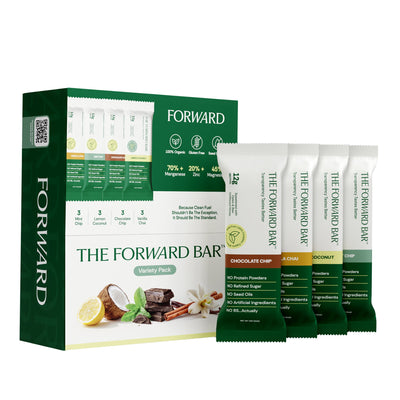
At The Forward Bar, we made a deliberate decision:
We don’t use protein powders.
Not whey isolate.
Not pea protein isolate.
Not soy protein concentrate.
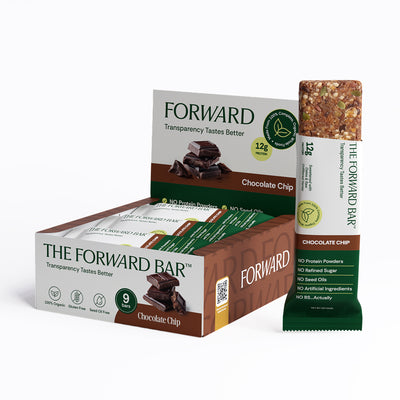
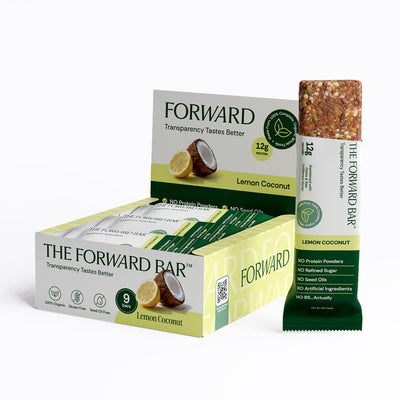
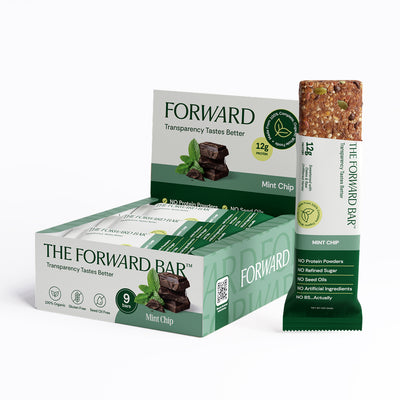
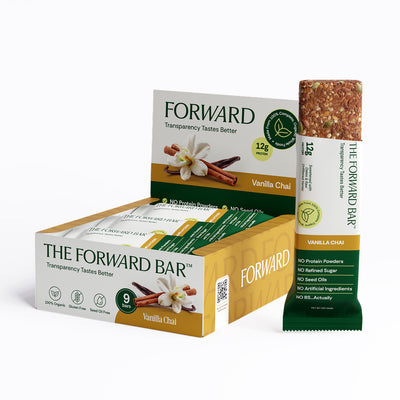
Instead, our protein comes directly from whole seeds.
Why?
Because whole foods exist in their natural matrix. They contain:
- Protein
- Fiber
- Healthy fats
- Minerals
- Phytonutrients
When you eat protein from whole seeds, you’re consuming it in its intact form, not as an extracted fraction.
Whole foods are less processed. Less concentrated. Less manipulated.
And importantly, they don’t require industrial isolation processes.
Whole Food Protein vs. Isolated Protein
Protein isolates are designed for high numbers on a label. They make it easy to advertise 20 or 30 grams of protein per serving.
But more isn’t always better.
Whole food protein:
- Digests more gradually
- Provides complementary nutrients
- Offers structural integrity
- Avoids the chemical extraction steps required for isolates
- The Consumer Reports investigation reminds us that concentration has trade-offs. When you isolate and refine, you may also concentrate unwanted elements.
Our approach is different.
We prioritize ingredient integrity over protein inflation.
Transparency Matters
One of the reasons this report gained national attention is because dietary supplements are not subject to mandatory pre-market FDA approval. That means protein powders do not require standardized heavy metal testing before being sold.
Consumers are left to rely on brand transparency and voluntary third-party testing.
As awareness grows, so does demand for simpler, less processed options.
At The Forward Bar, our philosophy is straightforward:
If we wouldn’t find it in a home kitchen, we question why it’s in a bar.
No protein powders.
No natural flavors.
No ultra-processed additives.
Just whole food ingredients that provide protein the way nature intended.
The Takeaway
The Consumer Reports study doesn’t mean all protein powders are dangerous. But it does highlight:
- Heavy metals are present in many protein supplements.
- Concentrated plant isolates may carry higher contaminant levels
- Supplements lack mandatory federal heavy metal testing standards.
For consumers using protein powder daily, it’s worth asking deeper questions about sourcing, testing, and processing.
For us, the conclusion was clear long ago.
Real protein should come from real food, not from a lab-separated powder.
When you build a bar from whole seeds, dates, and honey, you don’t need isolates to inflate the numbers.
You get protein.
You get fiber.
You get structure.
You get transparency.
All from whole foods.
That’s the Forward way.


